Kommeno · Corfu, Greece
Almost everyone who pictures Greece pictures the Cyclades. Corfu is the other country: olive groves instead of bare rock, Venetian arcades instead of blue domes, and a green, rained-on island that looks more like the Adriatic than the Aegean.
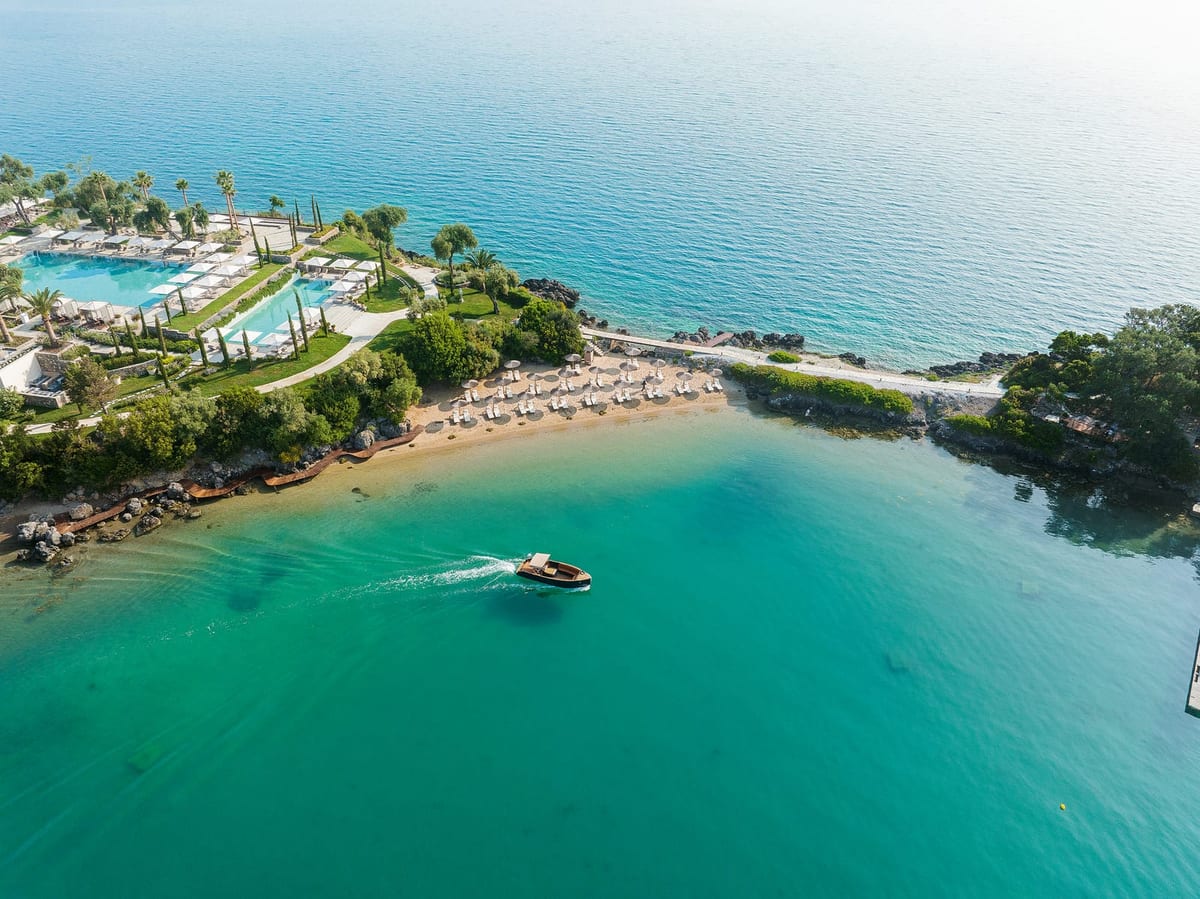
Grecotel Corfu Imperial has the best address on it. The resort occupies the end of the Kommeno peninsula, wrapped on three sides by water, with four private beaches in sheltered alcoves, sea decks cut into the rock, marble and cypress gardens hung with the owner’s collection of statuary, and the Venetian skyline of Corfu Town across the bay. It is an old-world summer palace rather than a design hotel, and building anything like it on this coastline is no longer permitted, which is a large part of why it has no real competition here.
The complication is the choice. Roughly three hundred rooms, villas and bungalows are sorted into thirty-eight categories across four collections, from a thirty-two square metre guestroom to a six-bedroom house for twelve. The tier names describe where you sleep far more than how good it is, and on this estate that gap is wider than usual. Here is how I read them.
The setting
Most Greek resorts have a beach. This one has a coastline.
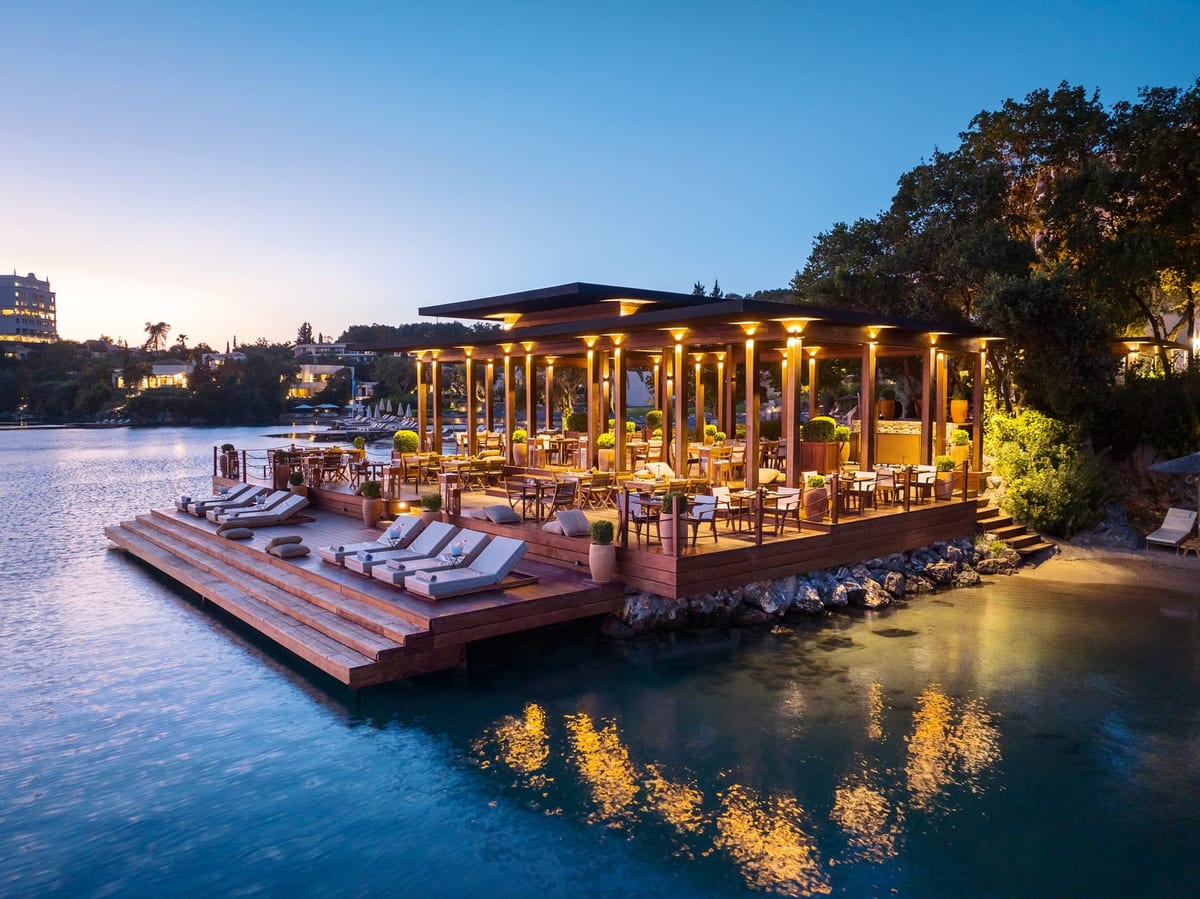
Kommeno is a low, wooded finger of land pushing into the Ionian about ten kilometres north of Corfu Town, and the resort holds the tip of it. That geography does the work: the sea is on three sides, the sunsets run across open water, and the grounds fall away from the main building through olive terraces and cypress walks to four private beaches and a run of wooden sea decks. Nothing is built above you and nothing is built beyond you.
The beaches are the underrated part. They sit in sheltered alcoves rather than on open coast, so the water is calm and clear and shallow at the edge, which is why this reads as a family resort even though most of it does not look like one. Four adults-only zones are set aside across the property to hold the other half of the balance, and that arrangement is the single reason couples and families can share this place in the same week without either group losing.
The trade for the seclusion is that Kommeno is a quiet residential peninsula rather than a village. There is no lane of tavernas at the gate. Corfu Town is twenty to thirty minutes by car, the airport is about the same, and the northeast coast villa belt around Kouloura and Agni is up the road. The resort softens that with a complimentary shuttle into Corfu Town four times a day and a complimentary boat that runs you around the peninsula, both of which are worth knowing about before you book a hire car for the week. Most guests take a car for a day or two rather than seven, and driving on Corfu is straightforward: winding, quick locals, nothing alarming.
Collection one
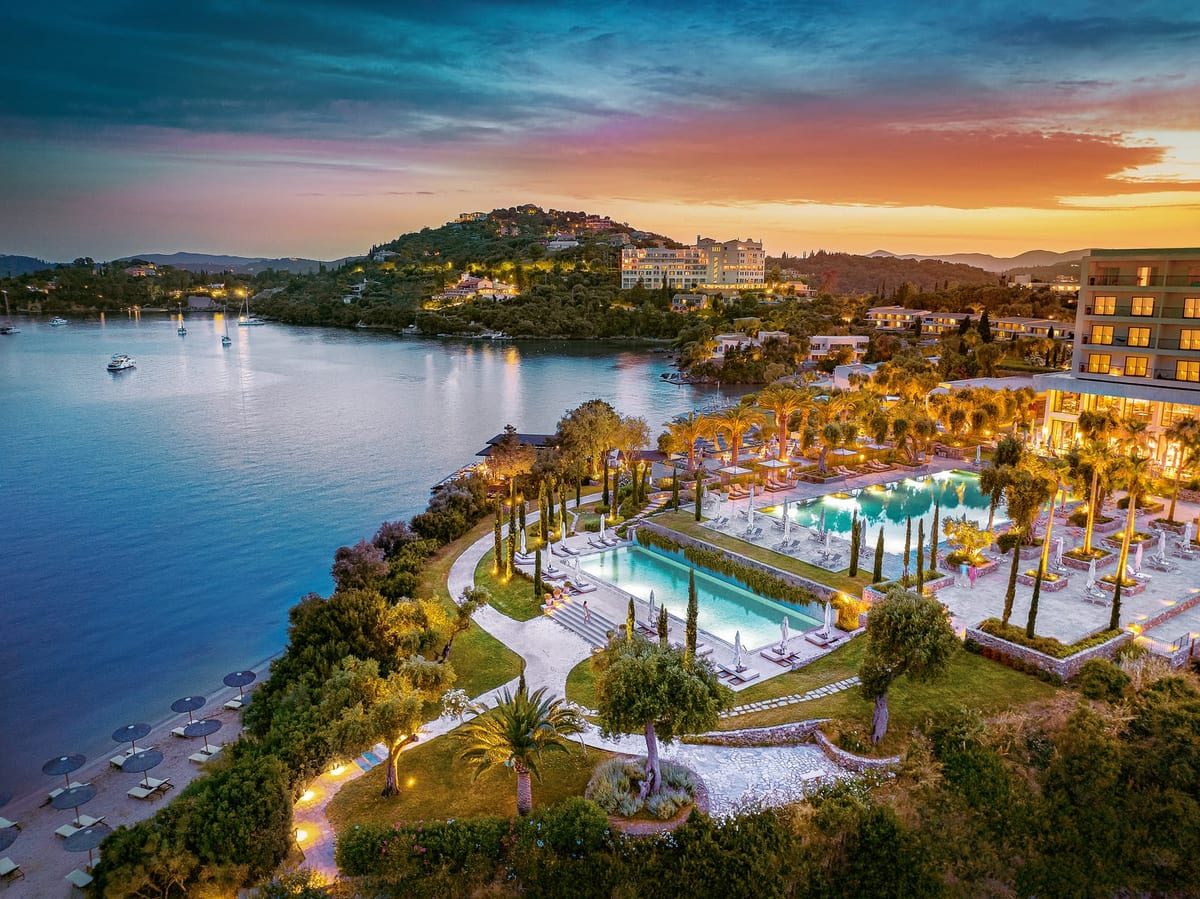
The main house, and the part of the resort that reads as a grand hotel: marble, palms, statuary, the stately register rather than the minimal one. It is stepped down the headland, which means the rooms are stacked and the views get better as you climb. It is not the whitewashed Cycladic cube some clients have in their heads, and the honest framing is that you are booking a view, a location and a certain amount of old-world theatre.
Standard guestrooms run about thirty-two square metres with a balcony. Deluxe faces the sea, Panoramic sits higher with a wider sweep, and Cruise is higher again with the bird's-eye line. The gap between them is real and it is entirely about floor level, which is exactly the kind of thing a booking engine will not tell you. Below the sea-view tier, the entry categories look out at greenery and drop the standalone bath, which is worth knowing if the bath is part of the picture.
Above those, the newer Deluxe Suites and Deluxe Family Suites take the top floor at around sixty-four square metres. The Imperial Suite is ninety-six with the view running across the bay to Corfu Town and the marina, the two-bedroom version doubles that, and the Presidential Suite sits at a hundred and ninety-two square metres over four balconies.
Collection two
Set back from the water among olive groves and pine, this is the low-rise half of the estate and it is where the resort stops feeling like a hotel. Bungalows sit in the gardens at around thirty-one square metres. Swim-up Junior Bungalow Suites open onto a shared pool that runs along the terrace, which is a specific and very good idea for anyone travelling with a child who wants to be in water from breakfast onward.
Il Boschetto is the family cluster inside it, laid out among silver-green olive trees, running from a forty square metre junior family suite through a fifty square metre two-bedroom to a sixty square metre apartment. There are more than twenty layouts in this pocket alone and several of them can be booked together, which makes it the obvious answer for a multi-generational group that wants to be adjacent without buying a villa. These are the layouts that solve the actual problem of a family holiday, which is a door between the adults and the children.
This is also where the value sits. The gap between a garden bungalow and a waterfront villa here is enormous, and a great deal of what you are paying for at the top of the range is the last twenty metres to the sea. Some families want exactly that. Many are better served by taking a Boschetto two-bedroom and putting the difference into a boat day and a week of good dinners.
Grecoland runs six days a week in season, split into Grecokids for four to six, Grecojuniors for seven to twelve, and Grecoteens for thirteen to seventeen with tennis, archery, mini golf and watersports rather than crafts. Four is the floor for drop-off: under-fours are welcome in the club but only with a parent or a babysitter alongside them, which is the detail that decides whether a holiday with a two-year-old is actually a break. GrecoBaby covers the equipment problem for nought to three, cots, monitors, buggies, sterilisers and the rest, ordered before arrival, with some items charged. Babysitting is available and charged separately. Children up to twelve stay free in selected room types and periods and eat free across a defined set of outlets and hours.
There is also an open-air cinema running a few nights a week, which is the sort of thing that quietly saves an evening with a nine-year-old.
The free-stay and free-dining terms are room-type and date specific, so treat them as a thing to confirm rather than a thing to assume.
Collection three
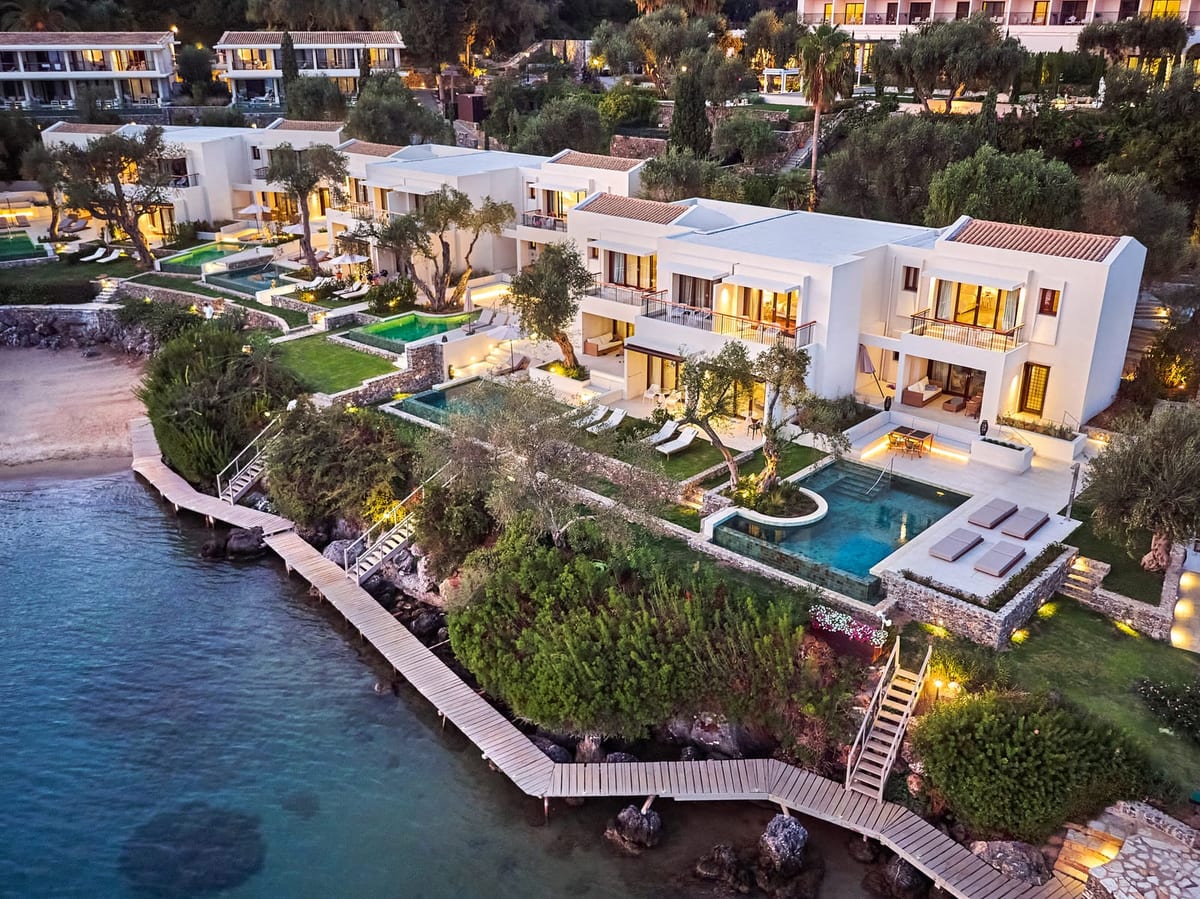
This is the part of the estate that has changed most, and it is the reason the resort now belongs in a conversation about villas rather than only about rooms. The waterfront runs from open-plan junior suites at the sea's edge up through maisonettes cut into the rocks to two, three, four and six-bedroom villas with private pools, private gardens, and in several cases a private sea deck or a private beach.
The names are worth decoding, because they are locations rather than grades. On the Rocs means built into the rock above deep water, with a terrace over the sea and steps down rather than sand. Waterfront means a lawn, a pool and a sea deck. Beachfront means you walk out onto sand. Three people who all book a villa here can have three genuinely different holidays.
The Junior Bungalow Suite Waterfront at around forty-two square metres is the quiet value pick in this collection: open plan, semi-private garden, direct beach access, and a fraction of villa money. The swim-up categories are the ones that go first, and with reason. Above them, Palazzo di Lago and Palazzo Sissy are two-level houses on the rocks with large private pools, and Palazzo Odyssia is the four-bedroom version with its own sea deck.
If you are booking two units for one party, ask about the docks. Most of the villas can be linked along the sea decks on request, which turns two separate houses into something closer to a compound. And note that not every villa is on the water despite the collection name, so the words “villa” and “waterfront” have to both be in the confirmation.
The category I point families at first is the Deluxe Family Suite, because it is the one that has both a private pool and direct beach access. Being able to send a child from the sand to the pool to the room without crossing the resort is worth more over a week than another twenty square metres.
Collection four
Two properties on the estate sit outside the categories entirely, and they are the answer when a group of eight to twelve wants a house with resort service attached to it.
Six bedrooms and four hundred and eleven square metres on the highest ground of the peninsula, for twelve, with its own kitchen. It is the least resort-like thing here: beamed ceilings, antique furniture, worn boards, a panorama across the sea and the island rather than a single view line. This is the one I would hold for a milestone birthday or a family reunion where the point is a house of your own with the restaurants and the staff of a five-star resort five minutes downhill. One caveat that the photographs will not tell you: Medusa sits on the hill, so it has no direct beach access. If somebody in the group wants to walk from bed to water, this is the wrong house.
Two hundred and forty-five square metres for eight, occupying its own small peninsula inside the resort, with two balconies and a private sea deck. Total exclusivity is the pitch and in this case the geography actually supports it. Where Medusa is a hilltop house, this is a house on the water, and the choice between them is really a choice between a view and a swim.
Palazzo Libro d'Oro is three hundred and twenty square metres over two levels for eight, beachfront with a private pool, and it is often the better-value version of the same brief. The six-bedroom beachfront villa runs to four hundred and fifty-eight square metres with two private pools and private steps to the beach, which suits two families travelling together better than either house above.
The table
Dining is genuinely the strong suit here, and it is also where the booking gets a decision in it rather than a default. One structural note that matters more than it sounds: in high season the restaurants are exclusive to hotel guests, which is why the place stays calm in August while the beaches on the rest of the island do not.
The Dine Club is the half-board programme, and it is better than most because it is a credit rather than a fixed menu. It gives breakfast plus lunch or dinner, a credit allowance usable across selected Grecotel restaurants on Corfu rather than only this one, so a dine-around at the sister property is part of the deal. It also gives two free à la carte dinners for every seven nights, including one at Danilia Village, and free dining for children. Drinks are not included, which is the line that catches people out.
It is very good value for a family staying a week and eating on site most nights. It is usually the wrong choice for a couple on four nights who want to drive to Corfu Town twice and eat at Yali once, because you end up paying for meals you are not there for. That calculation is different for every trip and it is the sort of thing worth ten minutes on a call rather than a guess at checkout.
The one real caveat
This is the honest weakness of the property, and it is also the reason to book it through somebody.
The last full renovation was in 2018, and since then the investment has gone into new villas rather than an even sweep across the estate. The result is a resort where the grounds, the service and the setting are consistently excellent and the rooms are not. Some categories have been genuinely rebuilt in the lighter, more contemporary register the group is moving toward. Others have been refreshed rather than renovated, and turn up with a dated bathroom or a layout that does not quite work. Advisors who have walked the property say the same thing in the same words: the decor and design are hard to read a pattern into, and the right room has to be specified rather than assumed.
None of that is a reason to avoid the hotel. Nobody comes back from here disappointed by the peninsula. It is a reason not to book a category off a website and hope, because at this property the distance between the best and the worst unit inside a single tier is larger than the distance between two tiers. I work the specific unit with the property rather than taking whatever the system releases, and on this estate that is not a nicety. It is most of the value.
The rest of it
The Elixir Spa runs over two floors: four private massage rooms and a couples room, an indoor pool heated in April, May and October, sauna and steam, a beauty salon and hairdresser, and a hundred and sixty-eight square metre open-air relaxation loggia. Sixteen and over, treatments charged, reservation required.
The gym is open around the clock. Yoga and aqua gym are complimentary; Pilates classes and personal training are charged. There are seven outdoor tennis courts, watersports off the beaches, and diving, riding, biking and golf arranged off site. This is a resort you can genuinely not leave for a week, which is either the appeal or the warning depending on who is reading.
The most-booked excursion here, by some distance, is the boat day to Paxos and Antipaxos. It is the right call: sea caves and cliffs on the Paxos west coast, and water at Antipaxos that genuinely looks the way it looks in photographs. Corfu Town is the other one, and the free shuttle makes it a half-day rather than a production.
April to the end of October, then closed, because there is almost no winter air service to Corfu. The shoulders are not the same product: Yali runs June to September, Merlin's and Danilia open in May, and the spa pool is heated precisely because April and October need it.
September is the week I would book. The sea is still warm, the resort is calmer, and the rates come off the peak. August is the opposite: it is the busiest family fortnight of the year here and a couple looking for quiet will not find it in a garden bungalow. Even in October the beaches fill, which tells you something about how good they are. A week is the standard stay and it is the right length.
Anyone whose mental picture of Greece is a blue dome and a caldera. Corfu is a different country visually and some travellers are quietly disappointed by that even when they enjoy the week, so it is better said out loud beforehand. Anyone who wants to walk out to a taverna after dinner, because Kommeno does not have one. And anyone shopping for a small design hotel: this is a grand resort with statues in the garden and children in the pool, and pretending otherwise helps nobody.
When you book this property through Fora, you’ll receive Preferred Partner benefits. Your advisor can share the full details.
Every booking is different, so what applies depends on the room category and your dates, and we go through it together before anything is confirmed. As an illustration, at Corfu Imperial these have included:
All of it sits on top of the rate rather than instead of it, so none of it costs you anything, and the planning itself is complimentary.
What actually matters here is narrower and more useful than the benefits: making sure the unit you are holding is the one you think it is. On this estate a category name tells you where you sleep and almost nothing about whether you will walk onto sand, climb down a ladder, or look at olive trees, and it tells you nothing at all about when that particular room was last touched. Fora has a working relationship with the sales team here, which is what makes it possible to hold a named unit rather than a category. That is the part I use.
The next step
Rock, lawn or sand. Main building or gardens. Half board or not. Those three questions decide the week, and none of them are answered by a room name. Send me the party, the dates and roughly the budget, and I will come back with the specific unit, the dining maths, and what the partner programme adds on your dates. Planning is complimentary.
← The Greek Islands field guide